
Fall Home Exterior Prep: Get Your Fort Wayne Home Ready for Winter
Fort Wayne usually sees its first hard freeze in late October or early November, and from then until March the outside of your house is in a freeze-thaw cycle that pries open every gap it can find. Fall home maintenance is about closing those gaps while you still can. The list below is the one we work through on our own homes, ordered by what fails first if you skip it. Most of it is a weekend; the rest is a phone call.
Why Fall Is the Deadline
Winter in northeast Indiana does not break things on its own. It finds things that are already a little bit broken and makes them worse. A hairline crack in caulk fills with water, the water freezes and expands, the crack widens, and it fills with more water the next day. By March the crack is a gap and the wall behind it is wet. The same mechanism works on a lifted shingle edge, a clogged downspout, and a loose piece of fascia.
That is why the fall list matters more than the spring one. Spring is about finding what winter did. Fall is about giving it less to work with. We cover the full-year version in our home exterior maintenance checklist; this article is the fall section, expanded.
1. Gutters and Downspouts
Gutters are first because a clogged gutter in winter causes problems on three fronts at once: ice dams on the roof above, water against the siding behind, and water pooling at the foundation below.
Clean them after the leaves are mostly down. In Fort Wayne that is usually the first or second week of November, after the oaks and maples drop. Cleaning in early October means doing it twice. If you have a lot of mature trees, plan on twice anyway.
Run water through every downspout. A gutter can look clean while the downspout is packed solid at the elbow. Put a hose in the top and watch the bottom. If it trickles or backs up, clear the elbow.
Check where the water goes. Downspouts should discharge at least four to six feet from the foundation. Extensions get kicked off during mowing season, and a downspout dumping at the foundation is the most common cause of the wet basements we hear about in March. Our guide on clogged gutters and foundation damage explains why this one is worth ten minutes.
Look at the hangers. Gutters full of wet leaves are heavy, and gutters full of ice are heavier. Any section that sags or has pulled away from the fascia will get worse under snow load. Refasten now, or have us do it.
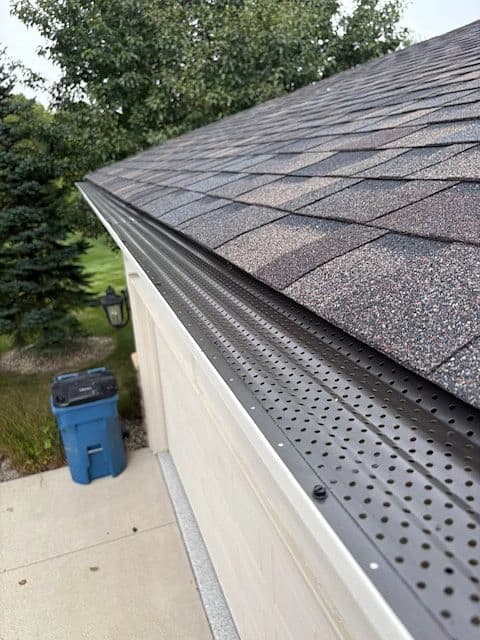
Consider guards if you clean more than twice a year. Leaf guards are not for every house, but on a heavily treed lot they turn a twice-a-year ladder job into an occasional rinse. See how often to clean gutters in Indiana for when they pay off. Our gutter team installs them, and fall is a good time because the gutters are getting cleaned anyway.
2. Roof
You do not need to get on the roof. Walk around the house with binoculars, or stand at the end of the driveway and look. What you are checking for:
| Look For | Why It Matters Before Winter |
|---|---|
| Lifted, curled, or missing shingles | Wind gets under a lifted edge and takes the shingle; snowmelt gets under it and into the decking |
| Granules collecting in the gutters | Shingles are shedding their protective layer; not an emergency, but a sign of age |
| Flashing pulling away at chimneys, vents, or walls | Most roof leaks start at flashing, and ice sitting against it finds every gap |
| Sagging sections or dips | Possible decking damage; snow load will make it worse |
| Moss or debris in valleys | Holds moisture against the shingles and traps snow where water needs to flow |
| Tree limbs within six feet of the roof | Ice-loaded limbs break, and the roof is where they land |
If you see any of the first four, get an inspection before snow covers the evidence. A single lifted shingle or open flashing seam is a small repair in October and a ceiling stain in February. Our roof inspection is free and takes about an hour.
If your roof is already showing the warning signs of needing replacement, fall is still a workable time to do it. Shingles seal well in temperatures above about 40 degrees, which Fort Wayne usually holds through early November, and the schedule is often easier than spring. Our roofing team does full replacements into late fall when the weather cooperates.
Ice dams: prevent them now, not in January
An ice dam forms when heat escaping from the attic melts the snow on the upper roof, the meltwater runs down to the cold eave, and it refreezes there into a ridge. Water pools behind the ridge and backs up under the shingles. The fix is almost never on the roof. It is in the attic.
- Check attic insulation depth. Indiana attics should have 14 to 18 inches of blown insulation. If you can see the joists, you are short, and that heat loss is what feeds the dam.
- Make sure soffit vents are not blocked. Insulation pushed into the eaves blocks the airflow that keeps the roof deck cold. Baffles fix it.
- Seal attic bypasses. Gaps around the attic hatch, plumbing stacks, recessed lights, and the chimney leak warm air straight to the roof deck.
If you had ice dams last winter, this is the month to deal with the cause. Clean gutters help at the margin, but a well-insulated and ventilated attic is what actually stops them.
3. Siding, Trim, and Caulk
Walk the house at arm's length from the wall. You are looking for any place water can get in and freeze.
Recaulk every failed bead. Around window and door frames, where siding meets trim, at hose bibs, dryer vents, light fixtures, and anywhere a pipe or cable passes through the wall. If the caulk is cracked, hardened, or pulled away from one side, scrape it out and run a new bead of exterior-grade, paintable sealant. Caulk needs temperatures above about 40 degrees to cure properly, so do not put this off to December.
Check the bottom course. Where siding meets the foundation, mulch and soil should sit below the bottom edge. Siding buried in mulch wicks moisture all winter.
Press on the trim and fascia. Soft wood at the corners of window trim or along the fascia board means water has already been getting in. Those spots will not survive another winter without getting worse, and a fascia repair is far cheaper than the rotted rafter tails it turns into.
Look for cracked or loose panels. Vinyl gets brittle below freezing and cracks when wind flexes it. A panel that is loose now is a panel in the yard in January. Refasten it, and do it before cold weather makes the vinyl too brittle to work with. Our guide to how Indiana weather damages siding and roofs explains why cold is so hard on vinyl.
If you are finding soft spots in more than one place, or the siding is pulling away in sections, that is past maintenance. Our siding team can tell you whether it is one wall or the whole house.
4. Windows and Doors
Every gap around a window or door is a draft all winter and an ice-forming water entry point.
- Feel for drafts on a windy day. Hold a hand, or a lit incense stick, around the frame and the sash. Movement means air is getting through.
- Check weatherstripping on doors. If you can see daylight at the edges with the door closed, or the strip is flattened and cracked, replace it. It is a ten-dollar part.
- Lock the windows. Locking pulls the sashes tight against the weatherstripping. Unlocked windows leak more air than people expect.
- Look for condensation between panes. Fog inside a double-pane window means the seal failed and the insulating gas is gone. That window is now a single pane in terms of heat loss.
- Check the sills. Soft or peeling sills on older wood windows are a water entry point that freeze-thaw will open up.
If more than a couple of windows fail these checks, you are paying for it every month from now until April. Our guide to the best replacement windows for Fort Wayne covers what to look for, and our windows and doors team installs replacements year-round.
5. Outdoor Water and Everything Else
The rest of the list is quick but each item has caused a real repair for someone we know.
- Shut off and drain exterior faucets. Disconnect hoses. If you have interior shutoffs for the hose bibs, close them and open the outside faucet to drain. A burst hose bib leaks inside the wall.
- Winterize the sprinkler system. Blow out the lines before the first hard freeze.
- Clear window wells and area drains. Leaves in a window well become a bathtub against your basement window.
- Check the grade. Soil should slope away from the house at least six inches over the first ten feet. Settled beds against the foundation collect water that freezes against the wall.
- Trim limbs back from the roof and power lines. Ice-loaded limbs are the main source of winter roof damage we see that is not an ice dam.
- Test the sump pump. Pour a bucket of water in the pit. Winter thaws put more water in the pit than people expect.
- Store or cover outdoor furniture and grills. Mostly for the furniture, but also so the grill is not against the siding all winter.
The Order to Do It In
If you only have one weekend:
| Priority | Task | Why This Order |
|---|---|---|
| 1 | Clean gutters and test downspouts | Affects the roof, siding, and foundation at once |
| 2 | Drain and shut off outdoor faucets | Fastest task with the most expensive failure |
| 3 | Walk the roof from the ground | Decides whether you need to make a call this week |
| 4 | Recaulk and press-test the trim | Needs mild weather to cure, so it cannot wait |
| 5 | Check windows and weatherstripping | Comfort and heating bill, less urgent than water |
| 6 | Grade, window wells, limbs, sump | Important, but a mild December day works too |
What to Hand Off
Anything on a ladder above one story, anything on the roof itself, and anything you pressed on and found soft. The free inspection we offer in fall is the same one we do in spring: roof, flashing, gutters, fascia, and siding, with photos of anything we find and an honest answer about whether it can wait until spring. Most of the time something can. Occasionally we find the thing that would have been a January emergency, and that is the whole point of doing it in October.
Common Questions
When is the first freeze in Fort Wayne?
The average first freeze (32 degrees) is around mid-October, and the first hard freeze (28 degrees or lower) usually lands in late October to early November. Caulk and shingle work should be done before that second date.
Can I still get a roof replaced in the fall?
Yes. Shingles seal properly above about 40 degrees, which Fort Wayne typically holds through early or mid November. Fall schedules are often more open than spring. See our roof replacement cost guide for what to expect.
Should I clean my gutters before or after the leaves fall?
After, or you will do it twice. For most Fort Wayne neighborhoods that means the first half of November. If you have a lot of trees, plan on one cleaning in late October and a final one once the trees are bare.
Do gutter guards prevent ice dams?
No. Ice dams come from attic heat loss, not gutters. Guards keep leaves out, which keeps meltwater flowing, which helps at the margin. The real fix is insulation and ventilation.
What is the single most important fall task?
Gutters and downspouts, because a clogged system causes roof, siding, and foundation problems at the same time. If you do nothing else, do that.
HomeAid Exteriors has served Fort Wayne and northeast Indiana since 2013 with roofing, siding, gutter, and window services. Fall inspections are free, and we will tell you plainly what needs attention before winter and what can wait. Financing is available.
Schedule a Free Fall Inspection
Roof, flashing, gutters, fascia, and siding checked before the snow, with photos of anything we find. Call (260) 385-6968.
Roofing & Exteriors in Fort Wayne
Local crews, local weather experience, and a free inspection for homeowners in Fort Wayne and Allen County.