5-Inch vs. 6-Inch Gutters: Which Size Is Right for Your Home?
For most Fort Wayne homes, 5-inch K-style gutters are the right size. For homes with a steep pitch, a large or complex roof, or a long run that collects water from several roof planes, 6-inch is the better choice, and it costs about $1 to $3 more per linear foot to get it.
That is the short version. The rest of this guide explains how to tell which group your house falls into, because the answer depends on the roof, not on the house's square footage.
What the Numbers Actually Mean
Gutter size refers to the width across the top of the trough. A 5-inch K-style gutter is 5 inches across the opening; a 6-inch is 6 inches. That one extra inch of width does more than it sounds like, because the trough also gets deeper.
| 5-Inch K-Style | 6-Inch K-Style | |
|---|---|---|
| Water capacity | Baseline | About 40% more |
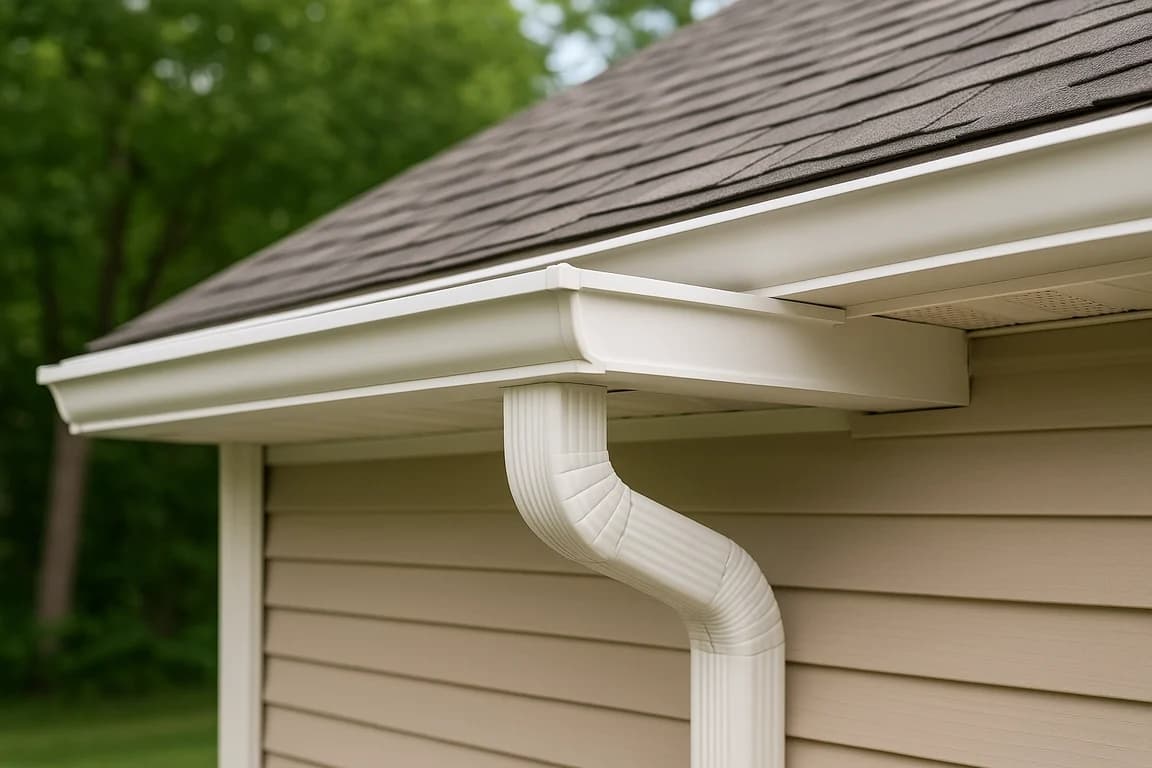
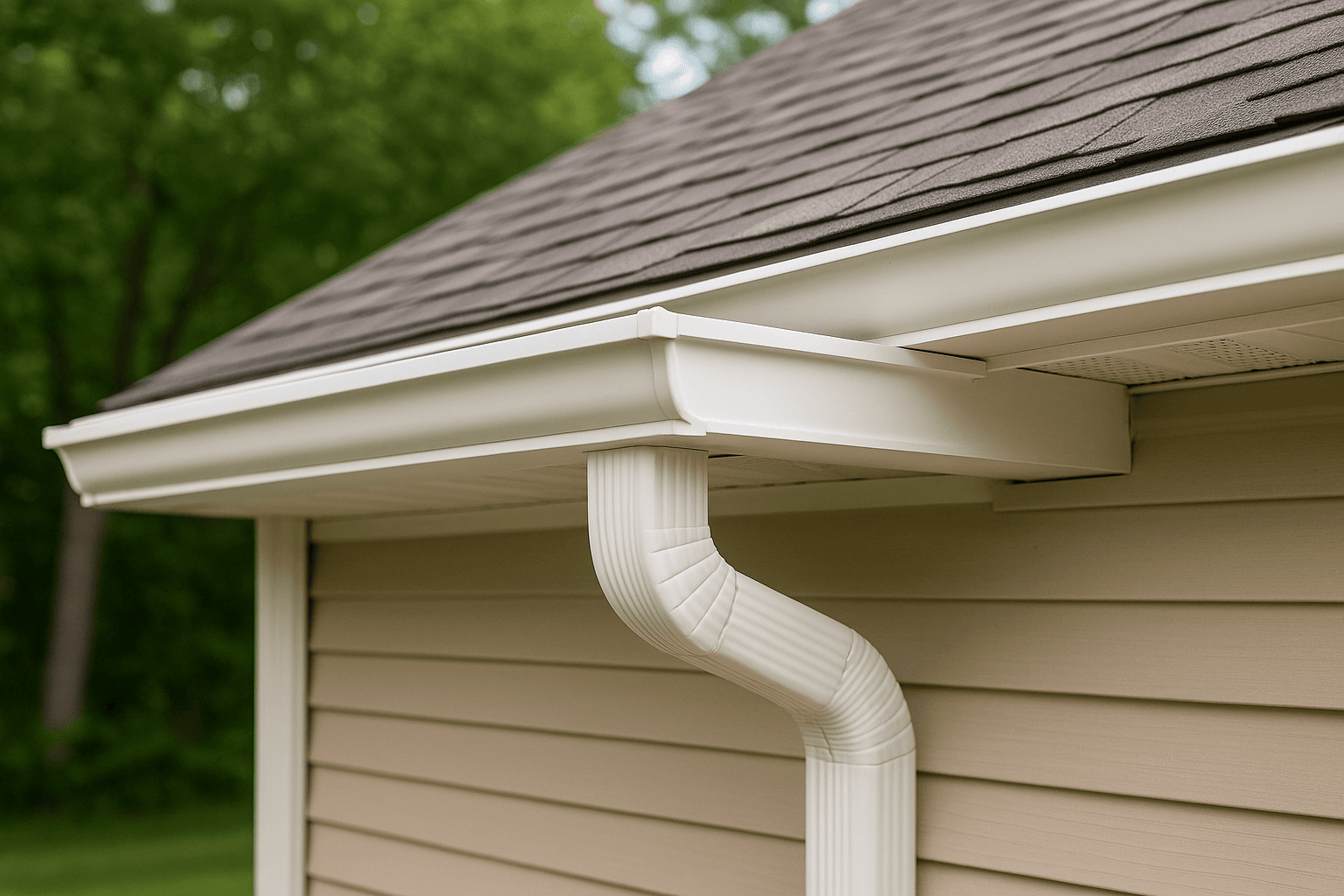
| Standard downspout | 2x3 inch | 3x4 inch |
| Downspout capacity | Baseline | Roughly double |
| Typical use | Most single-family homes | Steep, large, or complex roofs |
| Installed cost (seamless aluminum) | Base price | Adds about $1 to $3 per foot |
| Appearance | Standard profile | Slightly heavier fascia line |
The downspout pairing matters as much as the gutter itself. A 6-inch gutter with 2x3 downspouts is a bigger bucket with the same small drain. The water still backs up. When we install 6-inch, we pair it with 3x4 downspouts so the whole system drains at the higher rate.
When 5-Inch Is the Right Answer
A 5-inch system is not the budget option. It is the correct size for the majority of homes in Fort Wayne, Auburn, Columbia City, and the surrounding towns, and oversizing it buys nothing.
5-inch works well when:
- The roof pitch is moderate, roughly 6/12 or lower
- Each gutter run drains a single, simple roof plane
- The roof area draining into any one run is under about 1,000 square feet
- Downspouts are placed every 30 to 40 feet of gutter
Most ranches, split-levels, and two-story colonials in this area fit that description. If your current 5-inch gutters are clean, properly pitched, and still overflow in heavy rain, the fix is usually an extra downspout rather than a larger gutter.
When 6-Inch Earns Its Cost
Steep roofs
Water on a steep roof moves fast. On a 10/12 or 12/12 pitch it hits the gutter with enough speed to shoot past a 5-inch trough in a downpour, especially at the eaves of a tall two-story wall. The deeper 6-inch profile catches it.
Large roof planes
The amount of water a gutter run has to carry is set by the roof area draining into it. A big single-plane roof, say a long ranch with a 50-foot run on each side, or a home with a large attached garage sharing a gutter line, pushes a 5-inch gutter past its limit during the kind of summer storm we get here.
Valleys and converging planes
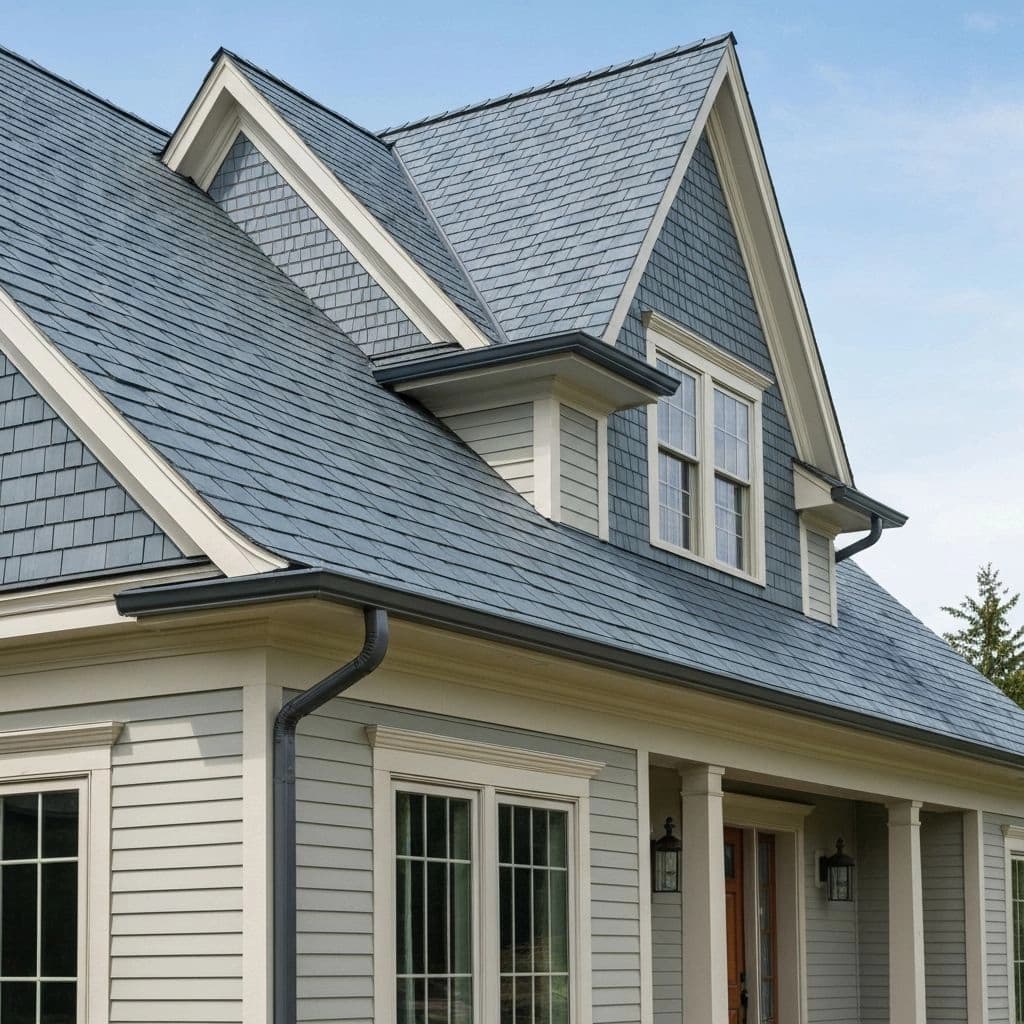
This is the one people miss. Where two roof slopes meet in a valley, all the water from both slopes funnels into one spot on the gutter below. That single point gets hit far harder than the rest of the run. Homes with multiple gables, dormers, or an L-shaped footprint often need 6-inch on the runs below valleys even if 5-inch is fine everywhere else.
Metal roofs
Standing seam and other metal roofing sheds water faster than shingles because there is nothing for the water to drag against. Combined with a steep pitch, metal roofs are a common case for going to 6-inch.
Heavy tree cover
A larger trough and a 3x4 downspout clog less readily than the 2x3 size, because leaves and seed pods have a wider path. Larger gutters are not a substitute for cleaning, but they do buy time between cleanings. If you want to reduce cleaning, gutter guards are the more direct answer.
A Simple Way to Estimate What You Need
You do not need an engineering calculation. Three questions get you most of the way there:
- How steep is the roof? If you would not feel comfortable standing on it, it is steep enough to matter.
- Is there a valley above any gutter run? If yes, that run is a 6-inch candidate.
- Do the current gutters overflow during heavy rain even when clean? If yes, the system is undersized somewhere, either in gutter width or downspout count.
When we come out for an estimate, we measure the roof planes and check how each one drains. Many homes end up with a mix: 6-inch on the runs that take the most water, 5-inch on the rest. There is no rule that the whole house has to match, and the difference in profile is barely noticeable from the ground.
Does 6-Inch Change the Look?
Slightly. The 6-inch profile sits about an inch taller on the fascia, so the shadow line along the roof edge is a bit heavier. On a two-story home with a tall fascia board, it looks proportionate and most people cannot tell. On a low ranch with a narrow fascia, 6-inch can look slightly oversized up close.
Both sizes come in the same colors, so matching to the trim is not an issue either way.
Cost Comparison
For a full seamless aluminum replacement on a typical Fort Wayne home, the total cost runs $1,200 to $3,500 depending on the amount of gutter, the number of downspouts and corners, and whether any fascia needs to be repaired first.
Going from 5-inch to 6-inch on the whole house adds roughly $1 to $3 per linear foot, so on 150 feet of gutter that is $150 to $450. Going 6-inch only on the runs that need it costs less than that.
Compare that with what undersized gutters cost over time. Overflow lands directly on the soil against the foundation, and in northeast Indiana's clay that is how basement water and foundation cracks get started. A few hundred dollars on the right gutter size is cheap insurance.
Seamless Is Still the First Decision
Whichever size you choose, it should be seamless. Sectional gutters in either size leak at the seams within a few years, and seams are exactly where Indiana's freeze-thaw cycles do their damage. We cover the full comparison in our seamless versus sectional guide. The seamless machine on our truck runs both 5-inch and 6-inch profiles, so the choice of size does not change the installation method.
Common Questions
Can I put 6-inch gutters on any house?
Yes. The hangers and fascia attachment are the same. The only practical limit is appearance on a home with a very narrow fascia board, and even then it is a matter of taste rather than function.
Will bigger gutters fix overflow?
Only if the overflow is caused by capacity. Overflow caused by clogs, a sagging run, or incorrect pitch will continue with any gutter size. The first step is always to confirm the existing gutters are clean and pitched correctly toward the downspouts.
Do I need 6-inch gutters for a metal roof?
Often, but not always. A metal roof with a moderate pitch and short runs can be fine with 5-inch. A steep metal roof, or one with valleys, usually warrants 6-inch with 3x4 downspouts.
Can I keep my 5-inch gutters and just upgrade the downspouts?
Sometimes. If the gutters themselves are in good shape and the problem is slow drainage, adding downspouts or upsizing to 3x4 can solve it. We will tell you if that is all you need.
How do I know what size I have now?
Measure across the top opening of the gutter from the front lip to the back edge. Five inches is standard; six is the larger size. Downspouts are 2x3 or 3x4 inches measured at the opening.
HomeAid Exteriors has served Fort Wayne and northeast Indiana since 2013 with seamless gutter installation in both 5-inch and 6-inch profiles. We size the system to the roof, not the other way around. Financing is available.
Get a Free Gutter Estimate
We measure the roof planes, check drainage, and recommend the size each run actually needs. Call (260) 385-6968.
Seamless Gutter Installation
Seamless aluminum gutters, downspouts, and guards for Fort Wayne and northeast Indiana homes.